Is a BBL Safe? How Modern Technique Changed the Risk Profile
Medically reviewed by Dr. Paulo Michels, Board-Certified Plastic Surgeon· Updated 8 September 2026
A Brazilian Butt Lift is safe when it is performed by a qualified plastic surgeon who places the transferred fat exclusively in the superficial subcutaneous layer — above the gluteal muscle — inside a properly equipped hospital. That single anatomical rule, combined with real-time ultrasound guidance, is what changed the risk profile of this operation over the past decade. Dr. Paulo Michels performs every Brazilian Butt Lift with dynamic ultrasound guidance at Elyzee Hospital in Abu Dhabi, and this article explains what that means in practice, what risks genuinely remain, and how to interrogate any surgeon you are considering.
Why did the BBL earn a dangerous reputation?
The anxiety around this procedure is not invented, and it is not fair to dismiss it. It comes from a specific technical problem in how the operation used to be performed by some surgeons.
The buttock has layers. Immediately under the skin is the subcutaneous fat. Beneath that sits the gluteus maximus muscle, and running within and beneath that muscle are large veins. Older approaches to gluteal fat transfer sometimes deposited fat deep, inside or below the muscle, on the reasoning that deeper placement gave better projection. If a cannula passed into one of those large veins while fat was being injected under pressure, fat could enter the venous system and travel to the lungs — a macroscopic fat embolism.
That mechanism is the source of essentially every serious complication that made headlines. It was not caused by fat transfer as an idea. It was caused by fat being placed in a layer where it should never have been placed.
What changed — why is subcutaneous placement now the rule?
Once the mechanism was understood, the answer was straightforward. International plastic surgery bodies converged on a clear instruction: fat is injected only into the subcutaneous space, above the muscle, and the cannula is never angled downward into the muscle.
This is the central shift. Not a new device, not a new brand of technology — a rule about anatomy. When fat stays in the shallow layer, the large gluteal veins are simply not in the path of the cannula. The specific catastrophic mechanism is removed from the operation rather than reduced.
The practical questions then become: how does a surgeon know they are above the muscle throughout the procedure, and how do they prove it rather than assume it? That is where ultrasound enters.
What does dynamic ultrasound guidance actually do in theatre?
Judging tissue depth by feel alone is possible for an experienced surgeon, but it is an estimate. Buttock anatomy varies considerably between patients — subcutaneous thickness differs from person to person and from region to region within the same buttock.
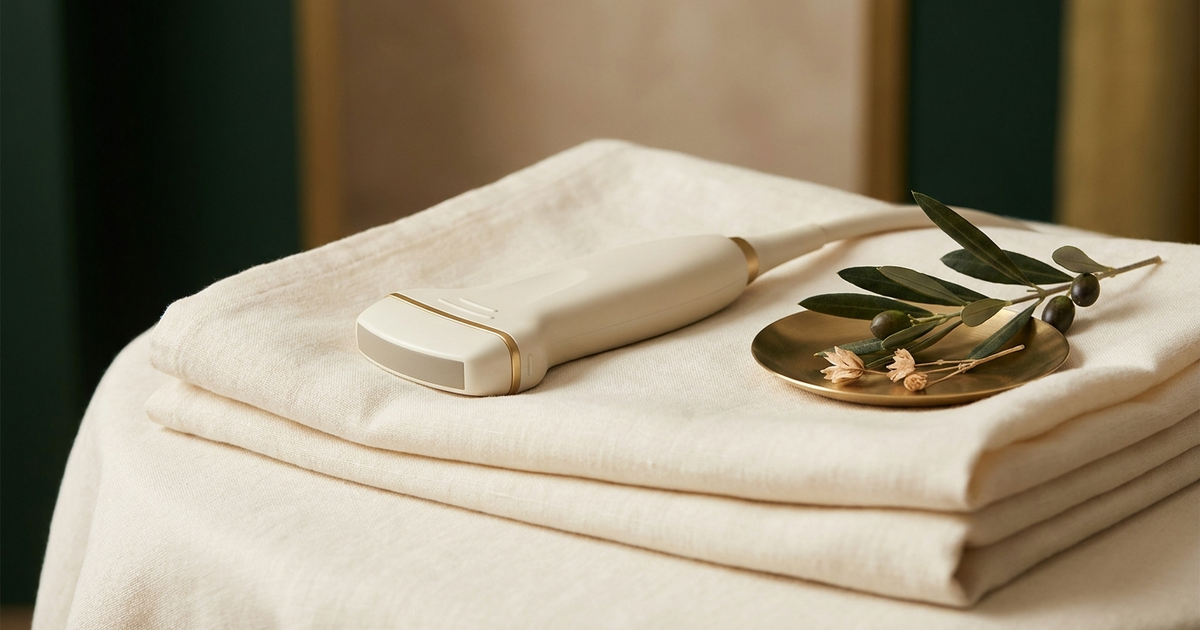
Dynamic ultrasound guidance replaces estimation with visualisation. A high-resolution probe is used in the operating room during the transfer so that the surgeon sees, in real time:
- The tissue layers — where the subcutaneous fat ends and the muscle fascia begins, mapped for that individual patient rather than assumed from an average.
- The cannula itself — its position and angle at each pass, confirming it has remained in the superficial plane.
- The vascular anatomy — the location of significant vessels in the region being treated.
This is why Dr. Paulo Michels performs the procedure exclusively with dynamic ultrasound guidance. It converts the safety rule from an intention into something confirmed continuously throughout the operation, and it virtually eliminates the risk of deep intramuscular injection.
It also affects the aesthetic result, incidentally. Even, controlled distribution across multiple shallow passes produces a smoother contour than large boluses placed blindly.
How much does the surgical setting matter?
A great deal, and it is often the part patients research least.
Gluteal fat transfer is a two-stage operation: comprehensive liposuction to harvest the fat, then the transfer itself. In most complete cases it is performed under general anaesthesia. That combination demands a full hospital environment — a dedicated board-certified anaesthesia team, monitoring, and immediate access to hospital resources if anything requires attention.
Dr. Michels operates exclusively at Elyzee Hospital in Abu Dhabi for exactly this reason. It is a regulated hospital setting with the equipment the operation requires, in-patient recovery suites, and structured post-operative monitoring during the first days. A procedure of this scale performed in a lightly equipped day clinic is a different risk proposition regardless of who holds the cannula.
Which risks remain even with a safe technique?
No honest answer to “is a BBL safe” stops at the embolism question. Modern technique addresses the most feared complication; it does not make the operation risk-free, and any surgeon who says otherwise should be treated with caution.
The realities that remain include:
- Partial reabsorption of transferred fat. The body reabsorbs a percentage of the graft, which is why a degree of over-correction is planned in the operating room.
- Asymmetry or irregular settling. Occasionally this warrants a minor revision once everything has stabilised.
- Bruising, prolonged swelling and fibrosis in the liposuction donor areas, managed with compression garments and professional lymphatic drainage.
- The standard risks of general anaesthesia, post-operative bleeding, and infection that accompany any surgical procedure.
- Result variability. Final shape takes three to six months to declare itself, and no outcome can be guaranteed in advance.
These are discussed plainly at consultation, because informed consent is part of safety rather than a formality attached to it.
Am I a safe candidate for a BBL?
Candidacy is a safety filter, not a formality — and it is where a responsible surgeon says no.
A stable, healthy body mass index matters in both directions. A BMI that is too high increases anaesthetic and post-operative risk; dramatic weight fluctuation makes the surgery a systemic risk and the result unpredictable. Sufficient donor fat in the abdomen, flanks, back or thighs is required for the transfer to be worthwhile at all. Patients who are very lean may be better served by discussing buttock augmentation with implants instead.
Dr. Michels also declines patients showing signs of body dysmorphic disorder, and those pursuing distorted expectations shaped by filtered images. Refusing an unsuitable case is one of the strongest safety measures a surgeon has.
What should I ask a surgeon before booking?
Five questions separate a modern practice from an outdated one. Ask them directly and expect specific answers:
- In which anatomical layer will the fat be placed? The only acceptable answer is the subcutaneous space, above the muscle. Any mention of intramuscular placement should end the conversation.
- Do you use real-time ultrasound guidance during the transfer, in every case? Not “sometimes”, not “for complex cases”.
- Where will the surgery be performed, and who administers the anaesthesia? A licensed hospital with a dedicated board-certified anaesthesia team.
- What are your criteria for declining a BBL patient? A surgeon with no exclusion criteria has none.
- Who provides my follow-up care, and for how long? Direct, continuing access to the operating surgeon rather than a rotating team.
If any answer is vague, the vagueness is the answer.
When should I contact the surgeon after surgery?
Routine reviews are scheduled in advance, and some soreness, tightness, bruising and asymmetric swelling are expected in the early weeks. Contact the surgical team promptly if you notice spreading redness over the skin of the buttocks or donor areas, a wound that opens or begins to discharge, one side becoming markedly more swollen, hot or tense than the other, pain that increases rather than gradually easing after the first several days, or fever. Sudden shortness of breath, chest pain or coughing warrants emergency care immediately rather than a phone call. Direct access to Dr. Michels during recovery is part of the plan, and no concern raised is treated as a nuisance.
How do consultations work, including from Dubai?
All consultations and surgery take place at Elyzee Hospital in Abu Dhabi. Dr. Paulo Michels — board certified by the Brazilian Society of Plastic Surgery, member of ISAPS, ASPS and EPSS, and Gold Medal winner for Best Body Contouring at the ISAPS World Plastic Surgery Olympiads 2025 — examines your anatomy, assesses donor fat availability, explains what volume and shape are realistic for you, and shows you where the fat will and will not go.
Patients travelling from Dubai and across the UAE are seen routinely, and you can read more about the practice on the plastic surgeon in Dubai page. Where possible, consultation, pre-operative tests, the surgical date and follow-up reviews are grouped to reduce the number of journeys, with the first days after surgery spent in Abu Dhabi under clinical monitoring. Consultations are unhurried and private, in English, Portuguese or Spanish.
Related procedureRead the full procedure page →
For patients in DubaiPlastic surgeon in Dubai — how visits work →