Rib Remodeling Recovery: Bracing, Breathing Comfort and Getting Back to Life
Medically reviewed by Dr. Paulo Michels — 23 July 2026· Updated 23 July 2026
Recovery after rib remodeling is short at the start and long at the finish: most patients are back at work and their daily routine within one to three days, yet the corset that guides the reshaped ribs into their new position is worn for two to three months, and the final waistline emerges over three to six months as the bone consolidates. That asymmetry — days of downtime, months of quiet consolidation — is the key to understanding the whole recovery, and it follows directly from what the procedure is: the angle of the last three ribs is remodelled, and nothing is removed. This guide walks through the recovery in detail, as Dr. Paulo Michels manages rib remodeling — one of his signature techniques — at Elyzee Hospital in Abu Dhabi, for patients from Abu Dhabi & Dubai and across the UAE.
Why is this recovery so different from other body surgery?
Because the operation itself is so different. Scarless rib remodeling narrows the waistline by gently adjusting the angle of the lower ribs — the last three, ribs 10, 11 and 12 — using ultrasonic remodeling of the bone through micro-punctures. No bone is removed, no long incision is made, and the whole intervention typically takes around 30 minutes.
Every one of those facts translates into recovery currency:
- No bone removed means the ribcage keeps its full structural and protective role — recovery is about a reshaped bone consolidating, not about the body compensating for a missing one. Remodeling and rib removal (costectomy) are fundamentally opposite procedures, and their recoveries are opposite too.
- No incisions means no incision-length wound to heal — the micro-punctures heal seamlessly, leaving no visible scar and removing most of the wound care that dominates other post-surgical recoveries.
- Around 30 minutes means minimal time under anaesthesia and far less surgical stress on the body — which is precisely why the early recovery is measured in days, not weeks.
What happens on the day, and how is comfort managed?
The procedure is performed under general anaesthesia, complemented by ultrasound-guided nerve blocks — long-acting local anaesthetic placed with precision around the surgical area. The blocks matter enormously for the recovery story: they carry patients through the earliest hours, when discomfort would otherwise be at its peak, so most people wake comfortable rather than bracing against pain.
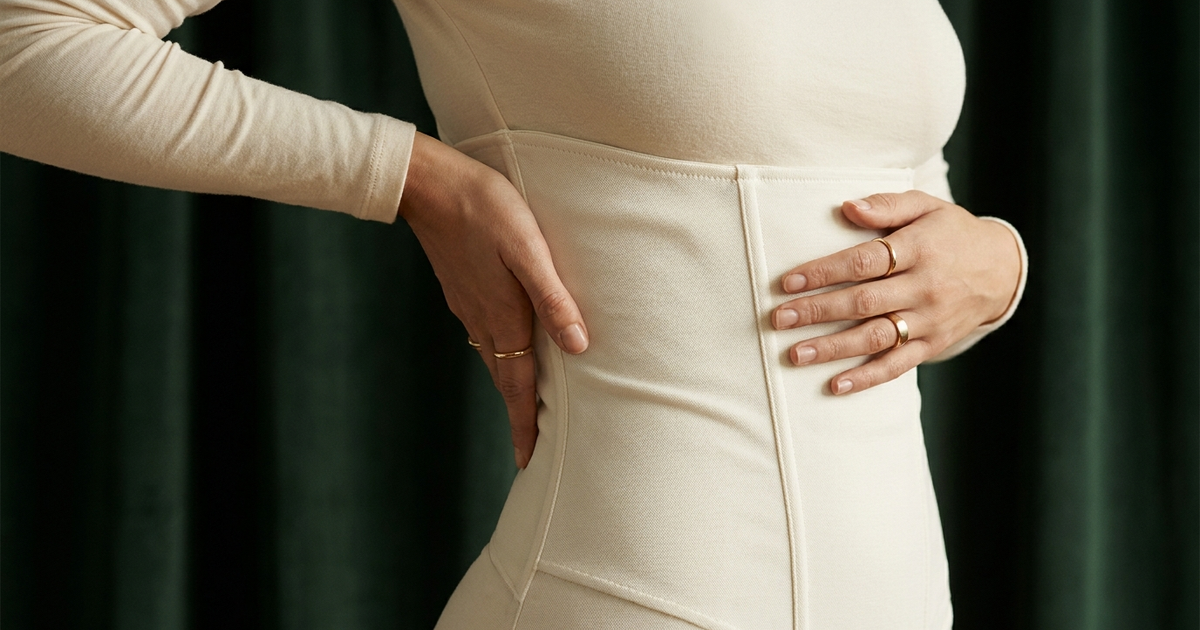
Before you go home, the specialised compressive garment — the corset — is fitted. From that moment, it becomes the central character of your recovery.
Why is the corset mandatory, and how long is it worn?
The corset is not a comfort accessory; it is part of the operation. The ribs have been remodelled to a new, narrower angle, and while the bone consolidates it needs an external guide holding it exactly where it was placed. That is the corset’s job: it ensures the reshaped ribs heal correctly and stabilise in their new, refined position.
Expect to wear it for two to three months, following the exact schedule your surgical team gives you. A few practical notes from the UAE context:
- Heat management. A corset worn through a Gulf summer means living in air conditioning, choosing breathable clothing over it, and keeping the skin beneath clean and dry. Skin irritation from sweat is the most common corset complaint — and the most preventable.
- Fit evolves. As early swelling settles, the corset may need adjusting so it keeps applying the right guidance. Raise fit questions at follow-up rather than improvising with the fastenings.
- Consistency beats intensity. The corset works by being worn as instructed, day after unglamorous day. Removing it “just for the evening” during the consolidation window undermines exactly the mechanism that produces the result.
What does breathing feel like during recovery?
This is the question rib patients quietly worry about most, so let’s answer it directly: rib remodeling does not damage the lungs or respiratory function. Because the ribs are reshaped rather than removed, their protective function remains fully intact, and the membrane nourishing the bone and the surrounding nerve networks are kept unharmed. There is no deficit to the lungs or internal organs.
What you may notice, in the early days, is awareness rather than impairment: the lower ribs move with every breath, so a deep breath, a laugh, a cough or a sneeze can remind you that this area has been worked on, and the corset itself takes some getting used to as a sensation. This settles as the tissues calm and the bone consolidates. Gentle, regular walking from the first days — which your team will encourage — keeps you breathing fully and comfortably while everything settles.
How fast do you really get back to life?
Genuinely fast, at the level of daily living:
- Days 1–3: most patients comfortably return to regular work and standard daily routines in approximately one to three days — for many, around day two. Desk work, school runs, errands and light daily activities resume almost immediately.
- First weeks: normal life continues in the corset. The area may feel tender and the sensation of the garment is a constant companion, but this phase is about routine, not convalescence.
- Exercise: light activity returns first. Strenuous cardiovascular exertion and torso-twisting exercises — the rotations of golf swings, tennis serves and certain gym work — must wait a few weeks, so the bone can fully solidify in its new shape before rotational forces act on it. Your team stages the return for you; the sequence matters more than the calendar.
The contrast with how this recovery sounds is worth naming. “Bone remodelling” sounds like a long convalescence. In reality, because nothing is removed and nothing is cut open, it is one of the quickest returns to daily life in body contouring — the patience is all in the corset and the consolidation, not in downtime.
When do you see the final waistline?
In stages. The silhouette changes from early on, but the early weeks also include swelling, and the corset is doing its quiet work beneath your clothes. The final result emerges over three to six months, as the remodelled ribs consolidate fully in their new angle and the tissues settle over them.
On average, many patients achieve approximately a 10 percent reduction in waistline measurement — a noticeably refined, natural-looking contour. But the outcome depends heavily on individual anatomy: baseline bone structure, and the amount of internal visceral fat, which limits how narrow a waist can safely become. Some patients see more change, some less. That is why the consultation includes a realistic, personalised assessment rather than a promised number.
It is also worth knowing that rib remodeling can be combined with liposuction of the waist and flanks, or with a tummy tuck (abdominoplasty), when the waistline story involves soft tissue as well as bone. A combined plan changes the recovery — the rib component stays fast, but the overall timeline follows the bigger procedure — and whether a combination makes anatomical sense for you is a consultation question.
Who does this recovery suit?
The typical rib remodeling patient is a healthy individual with a stable weight — very often a mother whose ribcage expanded during pregnancy and never fully returned, widening the waist. For her, the recovery profile is often the deciding factor: a 30-minute procedure, days off work rather than weeks, no scar, and a corset she can wear invisibly under clothing while life continues. The procedure does not affect reproductive organs or the ability to carry a child safely in the future — though a future pregnancy may cause the ribcage to naturally expand again.
When should you contact your surgeon?
Rib remodeling recovery is usually quiet, but a short list of observable signs deserves a same-day call to the clinic:
- Pain that is increasing day on day rather than steadily easing, or pain no longer controlled by your prescribed medication
- New or worsening difficulty breathing — this warrants contacting the clinic urgently, not at the end of the day
- Redness that is spreading around a puncture site, or discharge from one
- Swelling or bruising over the area that increases suddenly
- Feeling increasingly unwell rather than gradually better
None of these automatically means something is wrong, but each deserves prompt review. Dr. Michels’ team follows rib remodeling patients closely through the corset months and would always rather hear from you early.
Days of downtime, months of quiet work
Rib remodeling recovery asks very little of your calendar and a great deal of your consistency: back to life in one to three days, then two to three months of faithful corset wear while the reshaped ribs — all three of them still exactly where nature put them — consolidate into the waistline that fully reveals itself by three to six months. In consultation at Elyzee Hospital in Abu Dhabi — where patients come from Abu Dhabi & Dubai and well beyond — Dr. Paulo Michels assesses whether your anatomy suits the technique, sets realistic expectations for your result, and follows the consolidation with you month by month.
Related procedureRead the full procedure page →
For patients in DubaiPlastic surgeon in Dubai — how visits work →