Teardrop vs Round Breast Implants: Which Shape Is Right for You?
Medically reviewed by Dr. Paulo Michels — 2 November 2026· Updated 2 November 2026
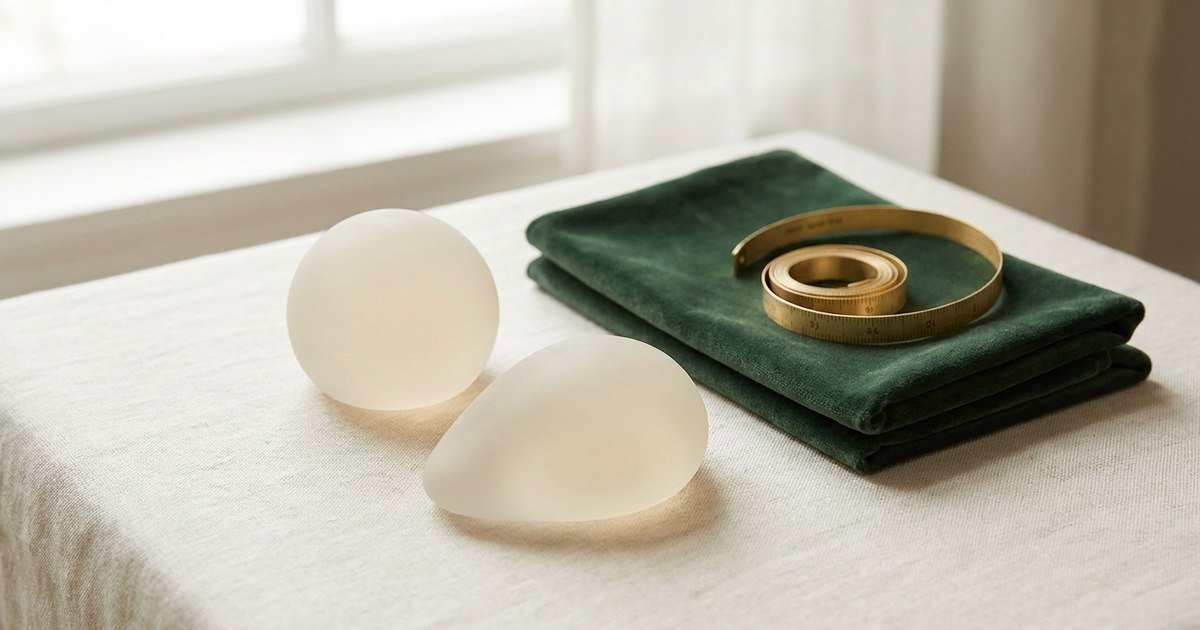
Round implants are symmetrical, so they cannot distort if they turn inside the pocket; teardrop (anatomical) implants are shaped with a defined top and bottom and must stay oriented to look right. For most patients, a modern cohesive round implant placed correctly already produces a teardrop silhouette when standing, which is why round implants are the default in contemporary practice. Dr. Paulo Michels, a Brazilian board-certified plastic surgeon and ISAPS Gold Medal winner for Best Body Contouring at the World Plastic Surgery Olympiads 2025, assesses shape alongside base width, profile and placement at Elyzee Hospital in Abu Dhabi, for patients from Dubai and across the UAE.
What is the actual difference between teardrop and round implants?
A round implant is a dome: the gel is distributed evenly, and the device looks the same whichever way you rotate it. An anatomical or teardrop implant is asymmetrical by design — less volume in the upper pole, more in the lower pole, with a sloped front profile intended to mimic the shape of a breast at rest.
On a table, side by side, the difference looks dramatic. Inside a breast, it is far less so, for two reasons. First, the implant is covered by muscle, gland, fat and skin, all of which modify the final shape. Second, gel behaves differently depending on whether you are lying down or standing up.
That second point is where most of the online debate about shape goes wrong.
Do round implants really look round?
Not in a standing patient. Cohesive silicone gel is soft enough to respond to gravity: once you are upright, the gel inside a round implant drifts downwards, filling the lower pole and leaving a gentler slope in the upper pole. The breast takes on a teardrop silhouette produced by physics rather than by the shape of the shell.
An anatomical implant, by contrast, is form-stable — it holds its engineered shape in every position, including lying down, when a natural breast would normally flatten and fall to the side. For some patients that stability reads as deliberately “done” rather than natural.
So the question is not “which shape looks natural”, but “which shape behaves naturally in your tissue”. The procedure page for breast augmentation explains why premium cohesive silicone is recommended over saline for exactly this reason: the gel mimics the feel and movement of natural breast tissue.
What is implant rotation, and why does it only matter for teardrop implants?
Rotation means the implant turns within the capsule the body forms around it. With a round implant, rotation is a non-event: a symmetrical device looks identical in any orientation, so nothing changes on the outside.
With an anatomical implant, rotation changes the breast shape. The fullest part of the device may end up at the side or at the top, producing an angular, off-axis or visibly uneven breast. The deformity does not correct itself and does not respond to massage or garments; it requires a second operation to reposition the implant and, usually, to revise the pocket.
This is not common, but it is a risk category that simply does not exist with round devices — and it is permanent surgical revision rather than a temporary inconvenience. Any honest shape discussion has to put it on the table.
Why are anatomical implants usually textured, and why does that matter?
To stay oriented, an anatomical implant needs the capsule to grip it. Historically, that grip came from a textured surface. Smooth implants slide within the pocket, which is harmless for a round device but unacceptable for a shaped one.
Modern safety standards have moved the other way. Heavily macro-textured implants have been linked to a rare condition called BIA-ALCL, and premium practice has largely transitioned to smooth or nano-textured surfaces such as Motiva to maximise patient safety. That shift is the single biggest reason anatomical implants have become a niche choice rather than a mainstream one: the surface that made them work reliably is the surface the field has moved away from.
If shape is not the main variable, what is?
Three things influence the final look far more than the silhouette of the shell:
- Base width. The implant should match the width of your chest wall. Too wide and it encroaches on the armpit or the midline; too narrow and the breast looks like a ball sitting on the chest. Sizing is measured — chest base width, existing tissue and skin stretch — not chosen from a cup size.
- Profile. Profile determines how far the implant projects forward. A moderate or low profile has a wider base and a subtle, natural slope; a high or extra-high profile has a narrower base and creates more upper-pole fullness and prominent cleavage. Profile, not shape, is what most patients are actually describing when they say they want a “natural” or a “fuller” look.
- Placement. With Dual Plane placement, the upper portion of the implant sits beneath the pectoral muscle and the lower portion under the breast gland. The muscle softens and hides the upper edge, producing the smooth downward slope people associate with teardrop implants, while allowing natural movement and lowering the risk of capsular contracture.
If you are at the stage of weighing dimensions and volume, the companion guide on choosing breast implant size covers how measurements and 3D simulation translate into a number.
Does shape change feel, coverage or rippling?
Feel is determined mainly by gel cohesivity and by how much of your own tissue covers the device. Highly cohesive, form-stable gel — the “gummy bear” category — holds its shape extremely well and does not leak if the shell is cut, but a firmer gel also feels firmer under thin tissue. Anatomical implants are typically made from the more cohesive end of the range, which is a trade-off, not an advantage in itself.
Visible rippling is most often a coverage problem rather than a shape problem. In a slim patient with little natural breast tissue, the answer is usually better coverage: Dual Plane placement, correct base width, and sometimes hybrid augmentation, in which a smaller implant is combined with fat harvested by liposuction and layered around the implant to soften its edges and deepen cleavage.
Shape also does not change the incision. The inframammary fold — a small 2–4 cm incision hidden in the crease under the breast — remains the preferred approach for preserving nipple sensation and breastfeeding ability. Recovery expectations are the same either way: deep muscle soreness rather than sharp pain for the first 3–5 days, desk work at around 3–5 days, no running or upper-body weight training for 4–6 weeks, back-sleeping and a compression bra for 4–6 weeks.
Is there any patient for whom a teardrop implant makes sense?
Shape can still be discussed in selected reconstructive or highly specific anatomical situations, where a form-stable device is used to build lower-pole shape that the patient’s own tissue cannot provide. Those are individual decisions made in consultation, not a general recommendation.
What a teardrop implant cannot do is lift. If your nipples sit below the breast crease or point downwards, no implant shape will correct that; you need a breast lift combined with augmentation, which can be performed in a single surgery. Patients comparing those two routes can read breast lift or implants before consultation.
In Dr. Paulo Michels’ practice
Dr. Paulo Michels recommends premium cohesive silicone implants with smooth or nano-textured surfaces, in line with the safety shift away from heavily macro-textured devices. He places them in the Dual Plane, so the muscle covers the upper pole and creates the natural downward slope patients describe when they ask for a teardrop look, and he reinforces the inframammary fold with the Internal Bra technique so the fold supports the implant’s weight over the years rather than letting the breast bottom out.
He declines saline implants as a default choice, because they feel firmer, look less natural and ripple more readily than cohesive gel. He also declines to treat implants as a substitute for a lift: where the nipple sits below the crease, he advises an augmentation-mastopexy rather than a larger or differently shaped implant.
The questions patients most often bring him are about shape and size at the same time — whether an anatomical implant will look more natural, and how big is safe. Both are answered with measurement: chest base width, existing tissue and skin stretch, reviewed with 3D simulation imaging during the consultation so the patient can see how different profiles and volumes would look on her own frame. Implants are inserted using a no-touch sterile funnel technique to reduce capsular contracture risk.
Consultations and surgery take place at Elyzee Hospital in Abu Dhabi; patients searching for breast augmentation in Dubai are seen there.
When should you contact your surgeon?
Call the clinic rather than waiting for your scheduled review if you notice:
- A sudden or progressive change in the shape of one breast — a new angular edge, fullness shifting to the side or the top, or one breast no longer matching the other after it had settled.
- One breast becoming noticeably larger, firmer or higher than the other over hours or days.
- Increasing pain after the first week rather than steadily decreasing pain.
- Redness, warmth or swelling that spreads rather than fades.
- Any opening of the incision, or fluid or discharge from it.
- A breast that becomes hard, tight or visibly distorted months or years later, which may indicate capsular contracture.
Do not try to diagnose yourself or to push, massage or reposition the breast. Describe what you can see and feel, and let the surgical team assess it. Most post-operative concerns are minor; the ones that are not are far easier to manage early.
Related procedureRead the full procedure page →
For patients in DubaiBreast augmentation in Dubai →