Breast condition · Abu Dhabi & Dubai
Bottoming Out & Implant Malposition
Also known as: bottoming out · implants too low · implants dropped below the fold · implants falling to the sides · lateral displacement · implants too far apart · high-riding implants · implants too high · double bubble · nipples pointing up after augmentation · implant malposition
Medically reviewed by Dr. Paulo Michels, Board-Certified Plastic Surgeon· Updated 29 September 2026
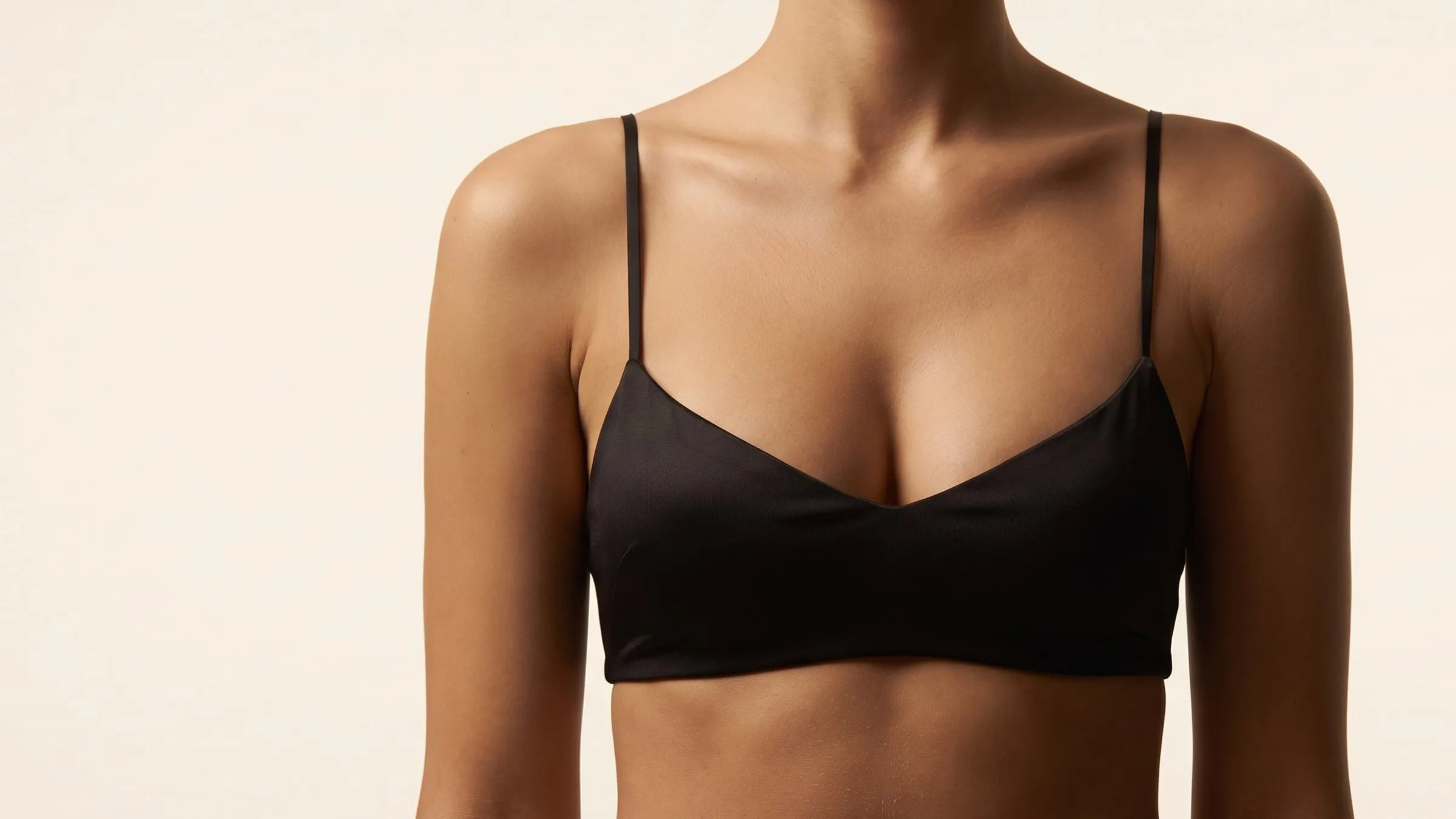
Implant malposition means a breast implant has settled in the wrong place: too low below the breast fold (bottoming out), drifted towards the armpit (lateral displacement), sitting too high, or showing a second crease (double bubble). It is usually a failure of the pocket's support, not of the implant itself. Dr. Paulo Michels corrects it in Abu Dhabi by rebuilding the pocket with permanent internal sutures.
Treated with
What does implant malposition look like?
Implant malposition is a broad term for a breast implant that has settled somewhere other than where it was intended to sit. Patients rarely use the medical word; they say their implants have “dropped”, “gone to the sides”, “never came down” or that they can see “a line across the breast”. These are four different patterns, and each has its own cause and its own correction.
- Bottoming out. The implant has slid below the natural fold beneath the breast. The lower breast looks long and over-full, the nipple seems too high or points upwards, and a fold scar may now be visible on the underside of the breast rather than hidden in the crease.
- Lateral displacement. The implant has drifted outwards towards the armpit. The gap between the breasts widens, cleavage disappears, and the implants fall to the sides when you lie on your back. This is the opposite problem to symmastia, where the implants move too far towards the middle.
- High-riding implants. The implant sits too high on the chest, with fullness concentrated above the nipple and a lower breast that looks empty or tight.
- Double bubble. A second crease is visible across the lower breast, so the breast shows two curves instead of one smooth contour.
One side can be affected, or both, and more than one pattern can exist at the same time — an implant can bottom out and drift laterally together.
What causes implants to move out of position?
The implant itself rarely fails. What fails is the support around it: the pocket in which the implant sits and the fold that forms its floor. Most malposition is a support problem.
Why does bottoming out happen?
The inframammary fold is a band of connective tissue that acts as the shelf at the base of the breast. It can give way when:
- the implant is heavy or wide relative to the patient’s tissue, so the fold carries more load than it can hold over time;
- the fold was lowered at surgery to fit the implant and was not reinforced afterwards;
- the patient’s tissue is naturally thin or elastic, or has been stretched by pregnancy or weight change;
- the lower pocket was dissected wider than the implant needed.
Why do implants drift to the sides?
Lateral displacement usually follows a pocket that is too wide on the outer side, either from the original dissection or from gradual stretching. An implant that is wider than the breast base, a chest wall that curves away naturally at the sides, and the repeated action of the chest muscle on an implant placed beneath it can all encourage the implant to move outwards, especially when lying down.
Why do implants sit too high?
In the first weeks it is normal for implants to sit high; they settle over the following months as swelling resolves and the lower breast stretches to accommodate them. An implant that is still high after this period is usually held up by a tightening scar capsule — capsular contracture — or by a lower pocket that was not released enough.
What causes a double bubble?
There are two versions. In the first, the implant sits below the original fold, but the fold’s attachments are still there, so a crease runs across the lower breast with implant bulging beneath it. In the second, the implant sits high while the patient’s own breast tissue slides down in front of it — often after pregnancy or weight change — so the breast shows a second contour above. The first is a fold problem; the second is closer to sagging around the implant, and is often corrected with a lift, as explained on the sagging breasts page.
How is implant malposition diagnosed?
Diagnosis starts with a careful examination, standing and lying down, with measurements compared side to side: nipple to fold, fold to the base of the breast, the gap between the breasts and the width of the breast base. You may be asked to tense your chest muscle, which shows whether the muscle is moving the implant. Photographs from after the original surgery, if you have them, are very useful.
Imaging is not always needed for malposition alone, but it is arranged when the examination raises another question — firmness suggesting capsular contracture, a change in shape suggesting rupture, or no record of which implant is in place. Ultrasound or MRI identifies the implant and the state of the capsule so the revision is planned on facts.
Can implant malposition be fixed without surgery?
Honestly, no. Once the pocket has stretched, nothing applied from the outside can tighten it again. Supportive or underwire bras, bands and taping may make the breast more comfortable and can help protect it from further stretching, but they cannot return an implant to its original position. Massage does not correct malposition and can make a stretched pocket worse. What non-surgical measures can do is buy time while you decide, and there is no urgency to correct malposition on its own unless it is causing discomfort or distress.
Which operation corrects implant malposition?
The correction is a form of breast implant revision, planned around the specific pattern. The central manoeuvre is capsulorrhaphy: the over-stretched part of the pocket is closed with rows of permanent internal sutures, and the implant is returned to its correct position. Dr. Paulo Michels performs it with the Internal Bra technique, which rebuilds the fold as a firm shelf and, where the tissue is weak, reinforces it with flaps of the patient’s own fascia — rather than a mesh as standard.
| Pattern | Main correction |
|---|---|
| Bottoming out | Lower capsulorrhaphy; fold rebuilt with permanent sutures; often a lighter or narrower implant |
| Lateral displacement | Lateral capsulorrhaphy to close the outer pocket; implant width matched to the chest |
| High-riding implant | Release or removal of the tight capsule, or release of the lower pocket; implant exchange if indicated |
| Double bubble (fold type) | Old fold released or adjusted; implant repositioned; new fold reinforced |
| Double bubble (sagging type) | Breast lift with implant repositioning or exchange |
The implant is often exchanged during the same operation. A pocket that stretched under a large or heavy implant is more likely to hold when the new implant is narrower or lighter and matched to the measured width of the chest. Implants used in revision are premium cohesive silicone with smooth or nano-textured surfaces (Motiva, Mentor, Polytech), inserted with a Keller Funnel. Where appropriate, the implant is moved to a Dual Plane position.
The full details of how the pocket is rebuilt, and how revision is combined with lifts, exchanges or capsulectomy, are on the Internal Bra procedure page. If you are weighing correction against removing implants altogether, the explant page and the guide to when implants need replacing will help.
What does recovery look like?
Recovery follows the pattern of a breast augmentation, with one difference: the internal sutures that rebuild the pocket must heal without tension, so the six-week protection period matters more than after a first operation.
- Light walking from the first day.
- Sleeping on your back for four to six weeks.
- A support bra day and night for four to six weeks.
- Desk work usually within about a week.
- No high-impact exercise or upper-body weights for four to six weeks.
Ultrasound-guided nerve blocks placed during surgery keep the first days comfortable. The shape settles over the following months. The augmentation recovery guide gives a week-by-week picture.
What are the limits and risks of correction?
Correction reliably improves the position of an implant, but it cannot change your tissue quality, the shape of your chest wall or the natural asymmetry most women have. Thin, stretched tissue and very large implants remain factors that can affect any result over the years. Risks include bleeding, infection, seroma, changes in nipple sensation, asymmetry, capsular contracture and the possibility that a further adjustment is needed. The internal sutures may occasionally be felt in very thin patients, or cause a temporary pulling sensation that settles with healing.
When should I see a surgeon?
See a surgeon if you notice a change in the position or shape of one or both breasts after the first few months, if the fold scar has moved onto the breast, if the implants now fall to the sides or touch in the middle, or if a breast has become firm, painful or distorted. A change in shape is not always malposition; it deserves examination either way.
How is implant malposition assessed at the consultation?
Dr. Paulo Michels, a Brazilian board-certified plastic surgeon with over 18 years’ experience, examines you standing and lying down, measures both breasts, reviews any records of the original surgery and arranges imaging if needed. Crisalix 3D simulation can show the effect of a different implant size or shape. You leave with a clear explanation of which pattern you have, why it happened and what correcting it involves. Consultations are in English, Portuguese or Spanish; the practice is WhatsApp-first on +971 50 106 7981, and all surgery takes place at Elyzee Hospital in Abu Dhabi, where patients from Dubai and across the UAE are seen routinely with visits grouped to reduce travel.
Questions, answered
Bottoming Out & Implant Malposition — your questions
What is bottoming out after breast augmentation?+
Bottoming out is when an implant slides below the natural fold beneath the breast. The lower half of the breast becomes long and over-full, the nipple appears to sit too high or point upwards, and the fold scar may ride up onto the underside of the breast instead of sitting in the crease. It is a support problem: the tissue at the base of the pocket has stretched and no longer holds the implant where it was placed.
How do I know if my implants have bottomed out?+
Look at three things in a mirror while standing. The distance from nipple to fold on the affected side has become longer; the nipple points upwards rather than forwards; and the fold scar, if you have one, is now visible on the lower breast rather than hidden in the crease. Comparing current photographs with ones taken a few months after surgery often makes the change obvious. A surgeon confirms it by measuring.
What is lateral displacement of breast implants?+
Lateral displacement is when an implant drifts outwards towards the armpit. The gap between the breasts widens, cleavage is lost, and the implants may fall noticeably to the sides when you lie on your back. It usually happens because the outer wall of the pocket was made, or has become, too wide for the implant, allowing it to move with gravity and with the action of the chest muscle.
Why do my implants sit too high?+
In the first weeks after surgery it is normal for implants to sit high and settle gradually as swelling resolves and the lower breast relaxes. If an implant is still high after several months, the usual causes are capsular contracture, where the scar capsule tightens and pushes the implant upwards, or a lower pocket that was not released enough for the implant to descend. Both are assessed by examination and, when needed, imaging.
What is a double bubble?+
A double bubble is a visible second crease across the lower breast. It appears when the implant sits below the original breast fold but the fold tissue is still attached, so the breast shows two curves, one above the other. It can also appear when an implant sits high and the natural breast tissue slides down in front of it. The treatment depends on which of the two patterns is present.
Can bottoming out be fixed without surgery?+
No. Once the pocket has stretched and the implant has descended below the fold, no bra, massage or exercise can pull it back up or tighten the pocket from the outside. A supportive bra can make the breast more comfortable and may help prevent further stretching, but the correction itself is surgical: the pocket is tightened and the fold rebuilt with permanent internal sutures.
What surgery corrects implant malposition?+
The core operation is capsulorrhaphy: the over-stretched part of the implant pocket is closed with rows of permanent internal sutures, returning the implant to its correct position. Dr. Paulo Michels performs it with the Internal Bra principle, rebuilding the fold as a firm shelf and, where the tissue is weak, reinforcing it with flaps of the patient's own fascia. The implant is often exchanged at the same time for one better matched to the chest.
Do I need new implants to correct malposition?+
Not always. If your implants are intact, of a suitable size and in good condition, they can sometimes be repositioned into the repaired pocket. Often, however, the implant that stretched the pocket was too large or heavy for the tissue, and exchanging it for a narrower or lighter implant is part of what makes the repair hold. The decision is made from measurements and the state of your tissue at the consultation.
Is a mesh needed to correct bottoming out?+
Usually not. Dr. Paulo Michels rebuilds the pocket and fold from the patient's own tissue with permanent sutures rather than inserting a scaffold material. Mesh or matrix materials have a place when the native tissue is genuinely too thin to hold a repair, and if that applies to you it is discussed openly at the consultation, including the fact that their use in cosmetic breast surgery is off-label in most jurisdictions.
Can malposition come back after it has been corrected?+
Any repair can stretch again if the same forces act on it, which is why the correction focuses on the cause: rebuilding support with permanent sutures, matching the implant width and weight to the chest, and protecting the repair during the first six weeks of healing. Significant weight change, pregnancy and very large implants remain factors that can affect any breast result over time.
Does implant malposition mean something is wrong with the implant?+
Usually not. Malposition is almost always a problem of the pocket and the surrounding tissue rather than a defect of the implant. That said, a change in the position or shape of a breast should always be examined, because a tightening capsule or, less commonly, a ruptured implant can also alter how a breast looks. Imaging is arranged when the examination suggests it.
Can Dr. Michels correct malposition from surgery done elsewhere or abroad?+
Yes. Many patients with malposition had their augmentation in another clinic, in the UAE or overseas. Bring any implant card or operative notes you have. If none exist, ultrasound or MRI can identify the implant and show the state of the capsule, and the revision is planned from that information. The aim is a practical plan, not a judgement on the previous operation.
How long is recovery after malposition correction?+
Recovery is similar to a primary augmentation, but the protection period matters more because the internal sutures must heal without tension. Expect light walking from the first day, back-sleeping for four to six weeks, a support bra day and night for four to six weeks, and no high-impact exercise or upper-body weights for four to six weeks. Most patients return to desk work within about a week.
What are the risks of revision for malposition?+
The risks are those of any breast revision: bleeding, infection, seroma, changes in nipple sensation, asymmetry, capsular contracture and the possibility that further adjustment is needed. Occasionally the internal sutures cause a temporary pulling sensation or can be felt in very thin patients. These risks are discussed individually at the consultation, and the operation is performed under general anaesthesia at Elyzee Hospital in Abu Dhabi.
Take the first step
Ask Dr. Paulo Michels about your case
Other breast concerns
Keep reading