Breast condition · Abu Dhabi & Dubai
Symmastia ("Uniboob")
Also known as: uniboob · synmastia · breadloafing · implants touching in the middle · no gap between breasts after implants · skin lifting off the breastbone · implants merged in the middle · bread loaf breasts · medial implant malposition
Medically reviewed by Dr. Paulo Michels, Board-Certified Plastic Surgeon· Updated 29 September 2026
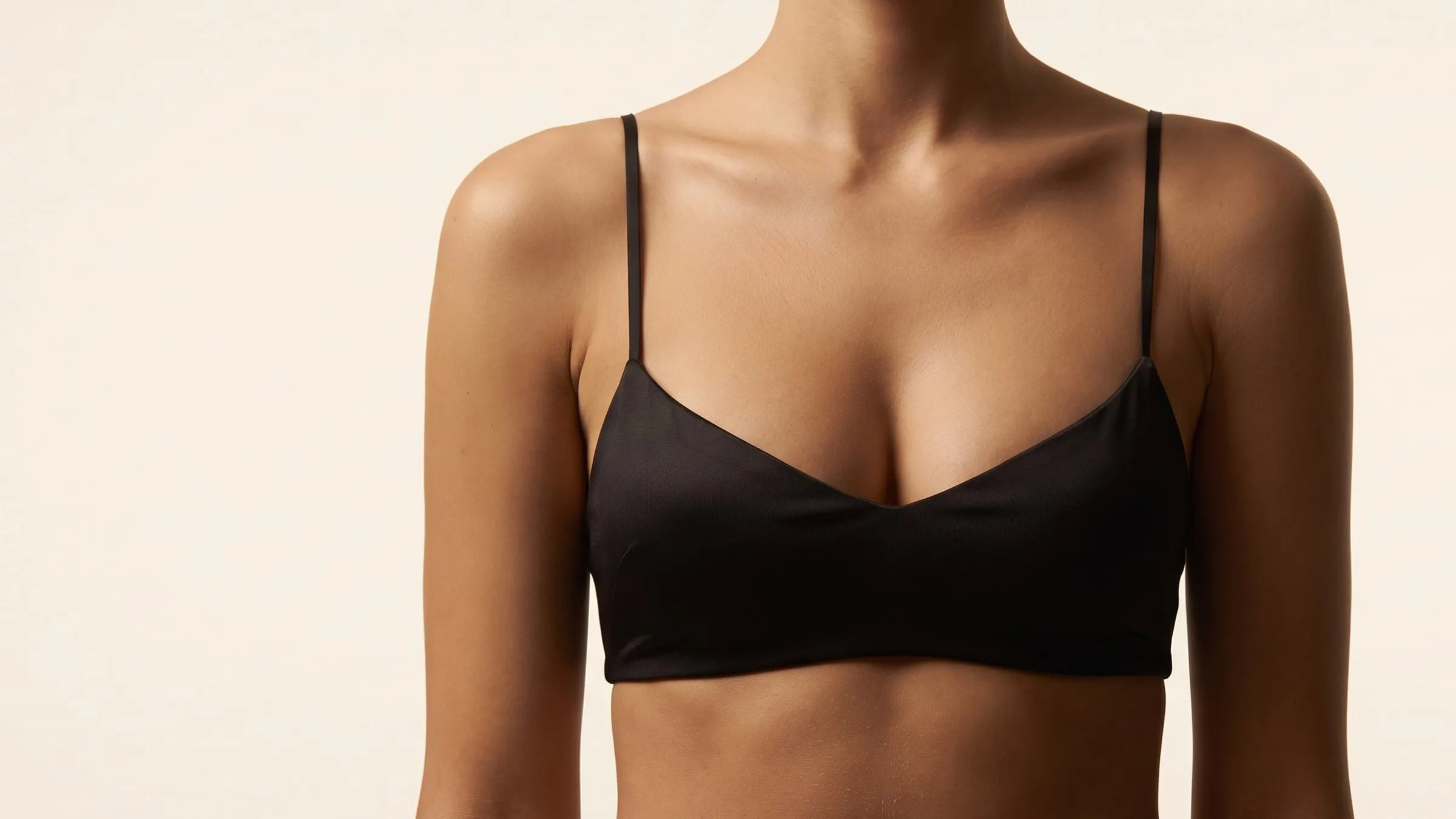
Symmastia, often called uniboob, is when the two breast implant pockets have joined across the breastbone, so the implants touch in the middle and the skin of the cleavage lifts off the chest. It is usually caused by a pocket dissected or stretched too far towards the midline. It does not resolve on its own; Dr. Paulo Michels corrects it in Abu Dhabi by closing the inner pocket with permanent sutures.
Treated with
What does symmastia look like?
Symmastia is easiest to recognise by what has disappeared: the natural dip between the breasts. Instead of two separate breasts with a defined cleavage, the chest shows a single, continuous curve across the midline. Patients describe it in different ways:
- the implants touch in the middle, or can be pushed across towards each other;
- the skin over the breastbone lifts away from the bone instead of lying flat against it;
- the cleavage looks bridged or flattened, sometimes described as a “bread loaf” shape;
- it is more noticeable when lying down, leaning forward or pressing the breasts together.
It is important to distinguish symmastia from close cleavage. Some women naturally have breasts that sit near each other, and a narrow cleavage after augmentation can be a perfectly normal result. The difference lies in the skin over the breastbone: in close cleavage it remains attached to the bone; in symmastia it has lost that attachment because the implant pockets have joined beneath it.
What causes symmastia?
Almost all symmastia seen today is related to breast implants, and it is a form of implant malposition — the implants have moved too far towards the middle. It is the mirror image of lateral displacement, where implants drift towards the armpits, described on the bottoming out and implant malposition page.
Implant-related symmastia
The usual cause is a pocket that extends too far towards the midline. Contributing factors include:
- dissection of the pocket close to, or across, the breastbone;
- excessive release of the chest muscle’s attachments along the sternum when the implant is placed beneath the muscle;
- implants with a base wider than the chest can accommodate, which press against the inner pocket and stretch it over time;
- thin tissue over the breastbone, which offers little resistance and makes any change more visible.
In many patients more than one factor is present. The desire for very close cleavage can lead to choosing wide implants, and wide implants in a narrow chest place steady pressure exactly where the tissue is thinnest.
Congenital symmastia
Less commonly, symmastia exists without implants: breast tissue or skin naturally bridges across the breastbone. This is a different problem, usually treated by reducing the tissue in the middle and restoring the skin’s attachment to the bone. Women who simply feel their breasts are too far apart have the opposite concern, discussed on the wide breast gap page.
How is symmastia diagnosed?
Diagnosis is made on examination. The surgeon looks at you standing and lying down, checks whether the skin over the breastbone is attached, measures the gap between the breasts and the width of each breast base, and assesses whether the implants can be moved across the midline. The thickness of the tissue over the implants is assessed, because it influences how the repair is planned.
Timing matters. In the first weeks after augmentation, swelling can make the breasts appear closer together than they will eventually be, and this settles on its own. Symmastia is diagnosed when the joined pocket persists after swelling has resolved.
Imaging is not always needed for symmastia itself, but ultrasound or MRI is arranged when there is no record of the implant, when the breast has become firm and a capsular contracture is suspected, or when a rupture needs to be excluded.
Can symmastia be fixed without surgery?
Once the pockets have joined, no. Garments that press on the cleavage are sometimes used during the early weeks after surgery to help the tissue settle against the breastbone, and one may be part of your plan after a repair. But a bra or band cannot close a pocket that has already opened, and massage cannot restore the skin’s attachment. Fillers or other injections have no role. What waiting can do is let swelling settle, so a real symmastia is not confused with early postoperative fullness.
Symmastia is not dangerous to your health. If it does not bother you, there is no medical need to correct it; the decision is yours.
Which operation corrects symmastia?
Symmastia is corrected with a breast implant revision centred on a medial capsulorrhaphy. The inner part of each implant pocket is closed with rows of permanent internal sutures, recreating a wall that holds the implant back from the midline and allows the skin over the breastbone to re-attach. Dr. Paulo Michels secures this repair with the Internal Bra technique, reinforcing it with the patient’s own tissue where it is weak, rather than a mesh as standard.
Three further decisions shape the correction:
| Decision | Why it matters |
|---|---|
| Implant width | A narrower base reduces pressure on the repaired inner wall; a different profile can keep similar fullness |
| Implant plane | Moving the implant to a different plane, such as a new pocket or Dual Plane, can give fresh tissue to hold the repair |
| Tissue reinforcement | Where the tissue over the breastbone is thin, the patient’s own tissue is used to strengthen the closure |
The implant is frequently exchanged for a premium cohesive silicone implant with a smooth or nano-textured surface (Motiva, Mentor, Polytech), chosen by measurement, and inserted with a Keller Funnel. Crisalix 3D simulation at the consultation helps you see how a narrower implant will look before deciding.
The Internal Bra page explains in full how pockets are rebuilt in revision surgery. If you are considering removing implants rather than correcting them, see the explant page.
What does recovery look like?
Protecting the repair during healing is essential, because the internal sutures must hold while the skin re-attaches to the breastbone.
- Light walking from the first day.
- Sleeping on your back for four to six weeks.
- A support bra day and night for four to six weeks, often with a garment that supports the cleavage.
- Desk work usually within about a week.
- No high-impact exercise or upper-body weights for four to six weeks.
Ultrasound-guided nerve blocks keep the first days comfortable, and the final shape settles over the following months.
What are the limits and risks?
A correction can restore a defined cleavage, but it cannot make very thin tissue over the breastbone thicker, and the final gap between the breasts depends on your anatomy as well as the repair. Recurrence is a recognised risk, which is why implant width, reinforcement and postoperative protection are planned so carefully. Other risks include bleeding, infection, seroma, changes in nipple sensation, asymmetry, capsular contracture and the possibility that a further adjustment is needed.
When should I see a surgeon?
See a surgeon if, some months after augmentation, your implants touch in the middle, the skin over your breastbone lifts away, or the cleavage has flattened or changed. Also seek review if a breast becomes firm, painful or changes shape. In the early weeks after surgery, contact your own surgeon if you are worried; early swelling is common and often settles.
How is symmastia assessed at the consultation?
Dr. Paulo Michels, a Brazilian board-certified plastic surgeon with over 18 years’ experience and a member of ISAPS, ASPS and EPSS, examines you standing and lying down, checks the skin attachment over the breastbone, measures your chest and reviews any records of your first operation. He explains which form of symmastia you have, what caused it and what a correction involves, with Crisalix 3D simulation to preview implant options. Consultations are in English, Portuguese or Spanish; the practice is WhatsApp-first on +971 50 106 7981, and all surgery takes place at Elyzee Hospital in Abu Dhabi, where patients from Dubai and across the UAE are seen routinely with visits grouped to reduce travel.
Questions, answered
Symmastia ("Uniboob") — your questions
What is symmastia?+
Symmastia is a condition in which the breasts, or more commonly the breast implants, meet across the midline of the chest. After augmentation it means the two implant pockets have joined over the breastbone, so the implants touch and the skin of the cleavage lifts away from the bone, creating a single continuous mound. The informal name is uniboob. It is a form of implant malposition in which the implants have moved too far towards the middle.
What causes symmastia after breast augmentation?+
The usual cause is a pocket that extends too far towards the midline. This can come from dissection close to or across the breastbone, excessive release of the chest muscle attachments near the sternum, or implants that are wider than the chest can accommodate, which stretch the inner pocket over time. Thin tissue over the breastbone makes the problem more likely and more visible.
Is symmastia the same as having close cleavage?+
No. Many women naturally have breasts that sit close together, and a narrow cleavage after augmentation can be a normal result. In symmastia the skin over the breastbone has lost its attachment and lifts away from the bone, so the dip between the breasts is flattened or bridged. A surgeon can tell the difference on examination by checking whether the skin over the sternum is still attached.
Can symmastia correct itself?+
In the first weeks after augmentation, swelling can make the breasts look closer together than they will be, and this settles on its own. True symmastia, where the pockets have joined, does not heal itself: the pocket stays open and the implants remain free to meet in the middle. If you are concerned in the early weeks, see your surgeon so the difference between swelling and symmastia can be assessed.
Can a bra or band fix symmastia?+
Garments that press on the cleavage area are sometimes used in the first weeks after surgery to help the tissue settle against the breastbone. They cannot close a pocket that has already joined or restore the skin's attachment once symmastia is established. Honest advice is that a garment may be part of the plan after correction, but it is not a substitute for surgical repair.
How is symmastia corrected surgically?+
The inner part of the implant pocket is closed with rows of permanent internal sutures, a medial capsulorrhaphy, so each implant is held back from the midline and the skin can re-attach over the breastbone. Dr. Paulo Michels secures this repair with the Internal Bra principle, using the patient's own tissue for reinforcement where it is weak. A narrower implant, and sometimes a change of plane, are often part of the correction.
Will I need smaller implants to correct symmastia?+
Often, but not always. An implant that is too wide for the chest is one of the forces that opened the pocket in the first place, so exchanging it for one with a narrower base helps the repair hold. The new implant does not have to be much smaller in volume; a different profile can keep similar fullness with less width. The choice is made from measurements of your chest.
Is symmastia dangerous?+
Symmastia is not dangerous to your general health. It is a problem of appearance and sometimes comfort, and it can make wearing certain clothes difficult. It is still worth having examined, because the same examination checks for other problems such as capsular contracture or a change in the implant, and because a clear diagnosis lets you decide calmly whether and when to correct it.
Can symmastia happen without implants?+
Yes, although it is uncommon. A congenital form exists in which breast tissue or skin naturally bridges across the breastbone. It is a different problem from implant-related symmastia and is treated differently, usually by reducing the tissue in the middle and restoring the attachment of the skin to the breastbone. The type is identified on examination.
Can symmastia come back after correction?+
Recurrence is a recognised risk because the tissue over the breastbone is often thin and the repair has to resist the pressure of the implants. The correction is designed to reduce that risk: permanent sutures, a narrower implant, reinforcement with your own tissue where needed and careful protection during the first six weeks. Your surgeon will explain how your particular tissue affects the chance of recurrence.
Can Dr. Michels correct symmastia from surgery done elsewhere?+
Yes. Symmastia is frequently seen in patients whose first augmentation was performed in another clinic, in the UAE or abroad. Bring any implant card or operative notes you have. If you have none, ultrasound or MRI can identify the implant and show the state of the capsule before surgery, and the revision is planned from that information.
What is the recovery after symmastia repair?+
Recovery is similar to a breast augmentation, with extra emphasis on protecting the repair. Expect light walking from the first day, sleeping on your back for four to six weeks, a support bra day and night for four to six weeks, often with a garment that supports the cleavage, and no high-impact exercise or upper-body weights for four to six weeks. Most patients return to desk work within about a week.
What are the risks of symmastia correction?+
The risks include bleeding, infection, seroma, changes in nipple sensation, asymmetry, capsular contracture, recurrence of symmastia and the possibility that further adjustment is needed. Internal sutures can occasionally be felt in very thin patients. The operation is performed under general anaesthesia at Elyzee Hospital in Abu Dhabi, and each risk is explained individually at the consultation.
Take the first step
Ask Dr. Paulo Michels about your case
Other breast concerns
Keep reading